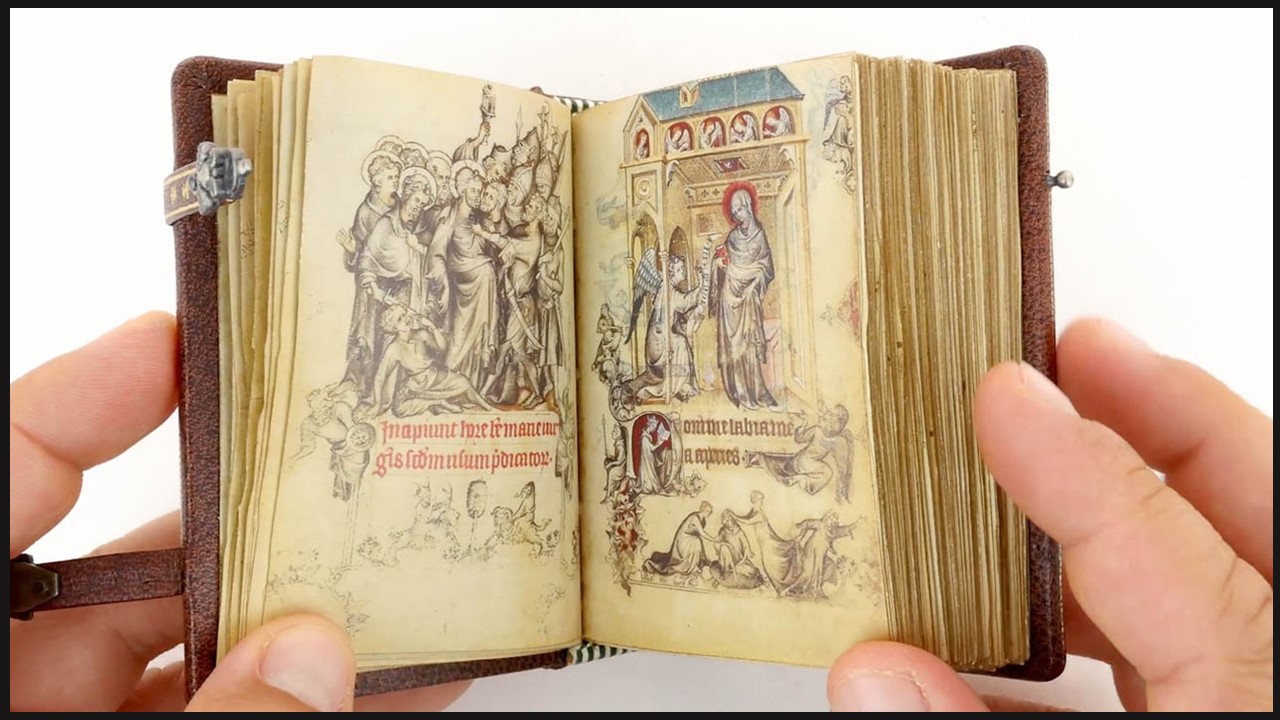
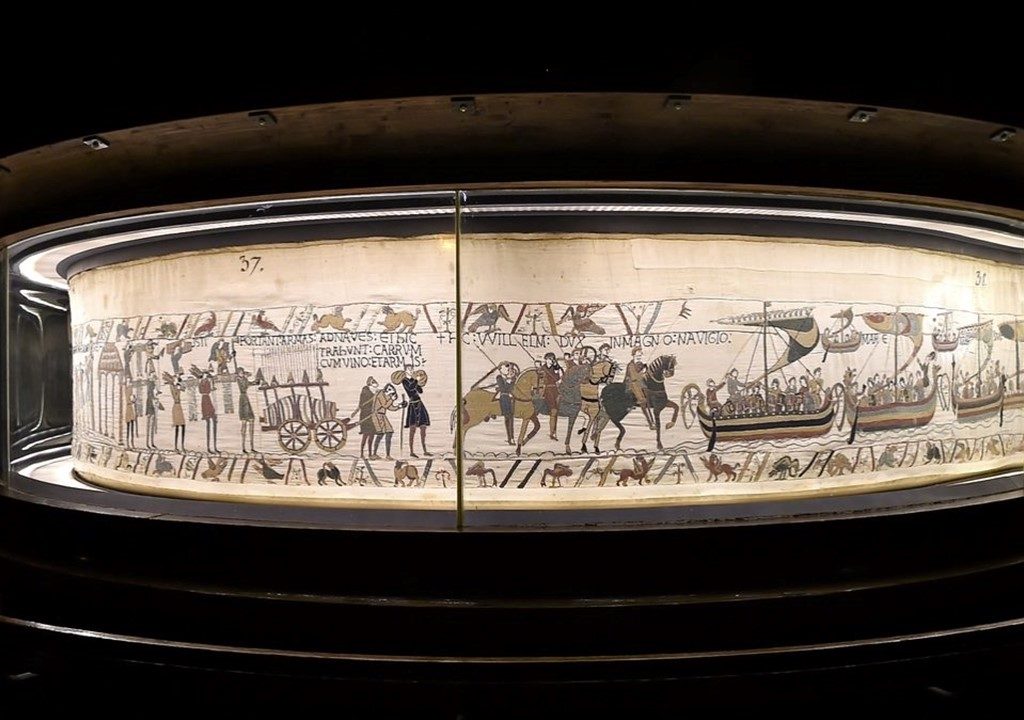
The Bayeux Tapestry intertwines art and conquest, narrating the Norman victory while blending memory, propaganda, and craftsmanship—suggesting that while not all art is conquest, power and history often shape its enduring story.
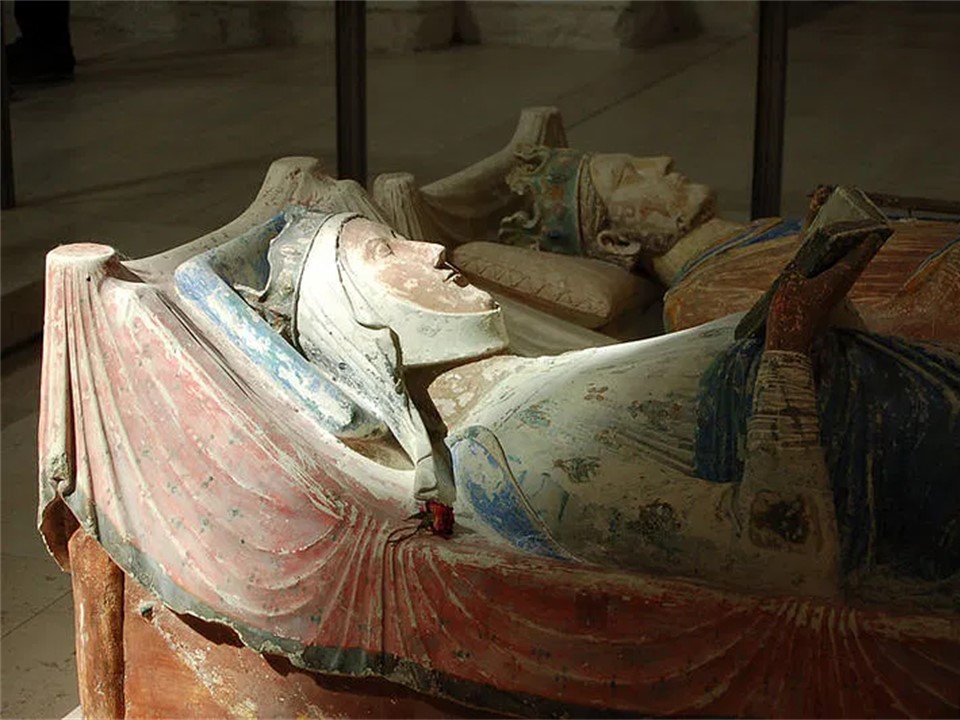
Eleanor of Aquitaine
On International Women’s Day, Eleanor of Aquitaine emerges as a powerful medieval queen—intellectual, patron of the arts, crusader, and political force shaping France and England’s history and culture.
Good Friday – Μεγάλη Παρασκευή

Today he who hung the earth upon the waters is hung upon a Tree. He who is King of the Angels is arrayed in a crown of thorns. He who wraps the heaven in clouds is wrapped in mocking purple. He who freed Adam in the Jordan receives a blow on the face. The Bridegroom of the Church is transfixed with nails. The Son of the Virgin is pierced by a lance. We worship your Sufferings, O Christ. Show us also your glorious Resurrection. (Good Friday – Μεγάλη Παρασκευή Twelfth Antiphon – plagal fourth mode) http://www.hchc.edu/assets/files/CD/All_Creation_Trembled_ebook.pdf
Σήμερον κρεμᾶται ἐπὶ ξύλου ὁ ἐν ὕδασι τὴν γῆν κρεμάσας. Στέφανον ἐξ ἀκανθῶν περιτίθεται ὁ τῶν Ἀγγέλων Βασιλεύς. Ψευδῆ πορφύραν περιβάλλεται ὁ περιβάλλων τὸν οὐρανὸν ἐν νεφέλαις. Ῥάπισμα κατεδέξατο ὁ ἐν Ἰορδάνῃ ἐλευθερώσας τὸν Ἀδάμ. Ἥλοις προσηλώθη ὁ Νυμφίος τῆς Ἐκκλησίας. Λόγχῃ ἐκεντήθη ὁ Υἱὸς τῆς Παρθένου. Προσκυνοῦμέν σου τὰ Πάθη, Χριστέ. Δεῖξον ἡμῖν καὶ τὴν ἔνδοξόν σου Ἀνάστασιν/ (ΜεγάληΠαρασκευή Ἀντίφωνον ΙΒ΄ – ἦχος πλ. δ΄) http://www.hchc.edu/assets/files/CD/All_Creation_Trembled_ebook.pdf

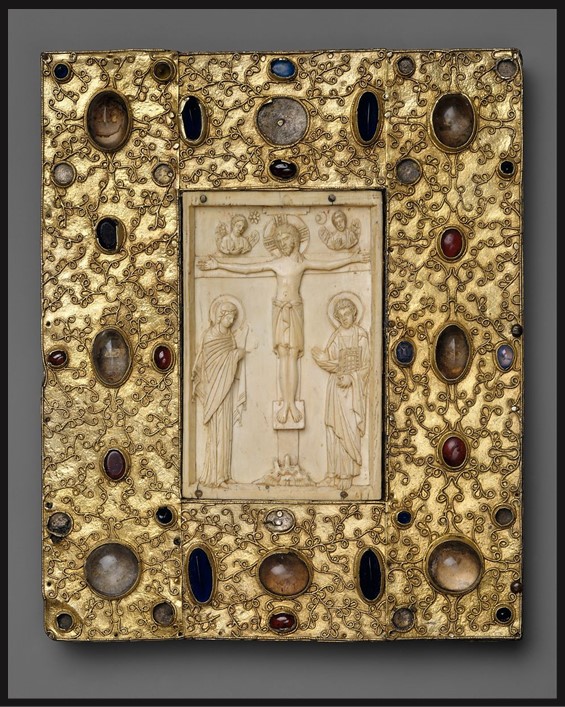
Byzantine Panels of Ivory Carvings were precious and treasured… just like the Ivory Panel in the MET coming from the Nunnery of Santa Cruz de la Serós in Spain. Set within an amazing gold frame of a Spanish goldsmith, the Byzantine Ivory Crucifixion Panel becomes an important testimony of Western admiration for the artistry of Byzantine craftsmanship, the high esteem accorded such Byzantine objects, and the cultural exchange, the artistic emulation, Byzantine artifacts initiated. The Glory of Byzantium, Art and Culture of the Middle Byzantine Era https://www.metmuseum.org/art/metpublications/The_Glory_of_Byzantium_Art_and_Culture_of_the_Middle_Byzantine_Era_AD_843_1261 p. 466
The Crucifixion plaque of Santa Cruz de la Serós originally formed the center of a Byzantine three-paneled icon. Typical to Byzantine Iconography, a Triumphant Christ stands erect on the Cross, his face serene, the eyes closed, his arms effortlessly horizontal, and his feet supported by a projecting platform. The “monumental” Cross in the center, seems to divide the compositional panel into 4 parts. The upper two smaller in size parts exhibit the sun and the moon, and two Angels. Standing under them, flanking the Cross, are the weeping Virgin Mary, and Saint John the Evangelist. They are both depicted holding a Book, an open one by Mary, and a bejeweled closed Book, by Saint John. Could the two represented Books be meant to remind the plaque’s viewer of Christ’s message of hope and redemption? https://www.metmuseum.org/art/collection/search/464015
The Metropolitan Museum Ivory is associated (by Goldschmidt and Weitzmann) with the Cortona Reliquary of the True Cross Ivory panel, and a collection of Ivory plaques known as the Nikephoros Group. These Ivories display simplicity of composition, stylistic homogeneity, rough but monumental style of carving, broad, blunt facial features, and rather large hands. The Nikephoros Group Ivories are dated to the middle of the 10th century because of an inscription on the back of the Cortona Reliquary of the True Cross Ivory panel mentioning emperor Nikephoros, most certainly the Byzantine Emperor Nikephoros II Phokas (963-969). https://www.metmuseum.org/art/metpublications/The_Glory_of_Byzantium_Art_and_Culture_of_the_Middle_Byzantine_Era_AD_843_1261 p. 466
The MET Byzantine Ivory of the Crucifixion has been one of the many gifts to the Nunnery of Santa Cruz de la Serós, outside the royal capital of Jaca, which was founded by Queen Felicia (d. 1085), wife of Sancho V Ramírez (r. 1076–94), king of Aragon and Navarre. It entered the Metropolitan Museum Collection in 1917 as a gift from J. Pierpont Morgan. https://www.metmuseum.org/art/collection/search/464015?&exhibitionId=0&oid=464015&pkgids=722 and https://www.metmuseum.org/art/collection/search/464015
A PowerPoint of all artworks presented for the Holy Week in the Greek Orthodox Church, 2022… is HERE!
Santa Maria foris portas at Castelseprio

https://upload.wikimedia.org/wikipedia/commons/5/5c/Maestro_di_castelseprio%2C_storie_dell%27infanzia_di_cristo%2C_datazione_incerta_tra_l%27830_e_il_950_dc_ca.%2C_15_nativit%C3%A0_1.jpg
I have been fascinated by the Castelseprio frescoes since I was a student, and I was introduced to their unique beauty and… ‘mysteries!’ When I finally visited Castelseprio in 1988, inside this amazing Church, enveloped in their splendor… I was transfixed, spellbound, awe-struck, entranced… forever. Years passed by, and I yearn to visit Castelseprio once more… stand in the middle of the Church, and experience… moments of the sublime.

https://commons.wikimedia.org/wiki/File:Santa_Maria_foris_portas2.JPG
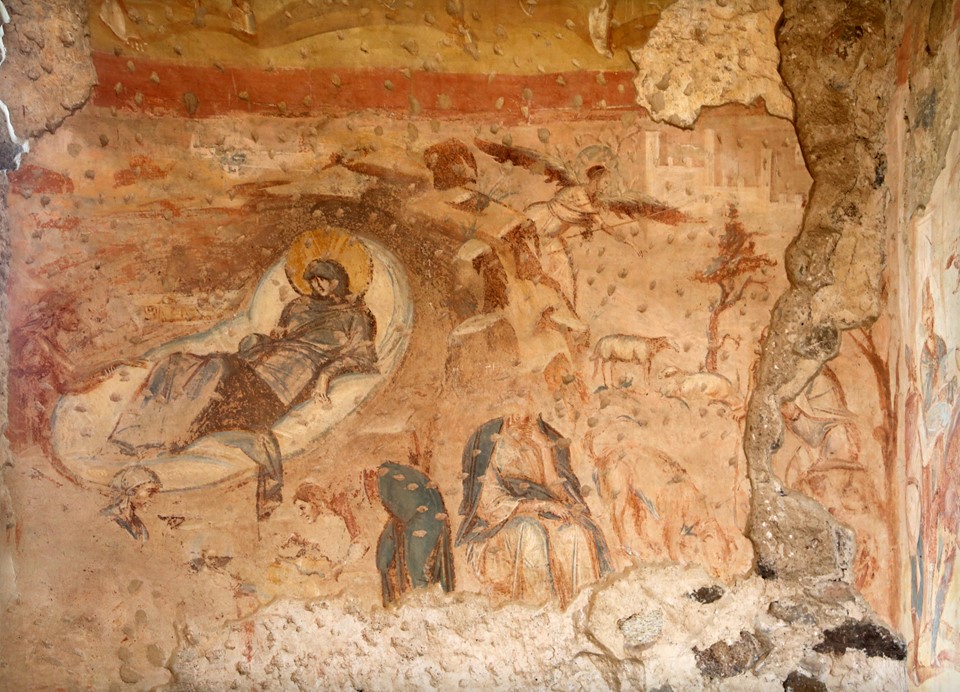
When the extraordinary Mariological programme of paintings on the walls of the church of Santa Maria foris portas at Castelseprio was first uncovered, and then quickly made known to the art historical community in an exemplary publication, historians of early medieval art were transfixed. Here was the missing link, the key which would provide the key which would provide the means to unlocking and understanding the role that the classical Byzantine tradition of art, played in the evolution of elite artistic developments in the various theatres of state formations in post-Roman western Europe, from papal Rome to Carolingian Aachen and Northumbrian Lindisfarne, in the early medieval centuries. The artists responsible appeared to be masters of an almost undiluted tradition of Greco-Roman painting, testifying to the enduring existence of a strain of what has been designated by Ernst Kitzinger as ‘perennial Hellenism’, continuing unbroken in one or more centers in the eastern Mediterranean and potentially available to the artist in western Europe, minded to recover some of the elements of ancient classical practice in an age in which overt classical form and subject-matter were valued at a high premium in the rival courts of Europe… write John Mitchell and Beatrice Leal… and I can not think of a better introduction to my Christmas POST on Santa Maria foris portas at Castelseprio Nativity Scene. https://www.academia.edu/13897079/_Co-authored_with_John_Mitchell_Wall_pantings_in_S._Maria_foris_portas_Castelseprio_and_the_tower_at_Torba._Reflections_and_reappraisal._In_Castelseprio_e_Torba_sintesi_delle_ricerche_e_aggiornamenti_ed._Paola_Marina_de_Marchi_2013

https://upload.wikimedia.org/wikipedia/commons/1/11/Maestro_di_castelseprio%2C_storie_dell%27infanzia_di_cristo%2C_datazione_incerta_tra_l%27830_e_il_950_dc_ca.%2C_15_nativit%C3%A0_3.jpg
The Church of at Castelseprio is so special and unique, many great scholars of Byzantine Art wrote about it… one way or another, more or less. I am fascinated by the surviving frescoes within the Church, the “ambiance” they create, their “Hellenistic” origin, stylistic characteristics (brushwork, colour, light), and drama in their compositions. I find it irresistible how the unknown “Greek” painter of the time, used diagonal perspective, a three-quarter view of both persons and objects, and a constant search for depth of space, to enhance his brilliant style. In compositions like the Nativity scene, I admire the portrayal of illusionistic forms within a deep, open landscape, and how the master artist used illusionism to enhance and at the same time, transfigure reality. I like… everything!
Merry Christmas
Preparing for this POST (this is the most important part for every BLOG POST of mine)… wondering how “Hellenistic,” in rendering and mood, the Castelseprio frescos are… I reread The Hellenistic Heritage in Byzantine Art, by Ernst Kitzinger, Dumbarton Oaks Papers, Vol. 17 (1963), pp. 95-115 (37 pages) https://www.jstor.org/stable/1291192?seq=13#metadata_info_tab_contents , and Castelseprio and the Byzantine “Renaissance,” by Charles R. Morey, The Art Bulletin Vol. 34, No. 3 (Sep. 1952), pp. 173-201 (37 pages), https://www.jstor.org/stable/3047419?seq=1#metadata_info_tab_contents
For a PowerPoint on Castelseprio’s Nativity Scene, please… Check HERE!
The Limbourg Brothers… and the 1st of May

The Limbourg Brothers are among my favorite artists! The month of May in “Très Riches Heures du Duc de Berry,” the manuscript, is another favorite.
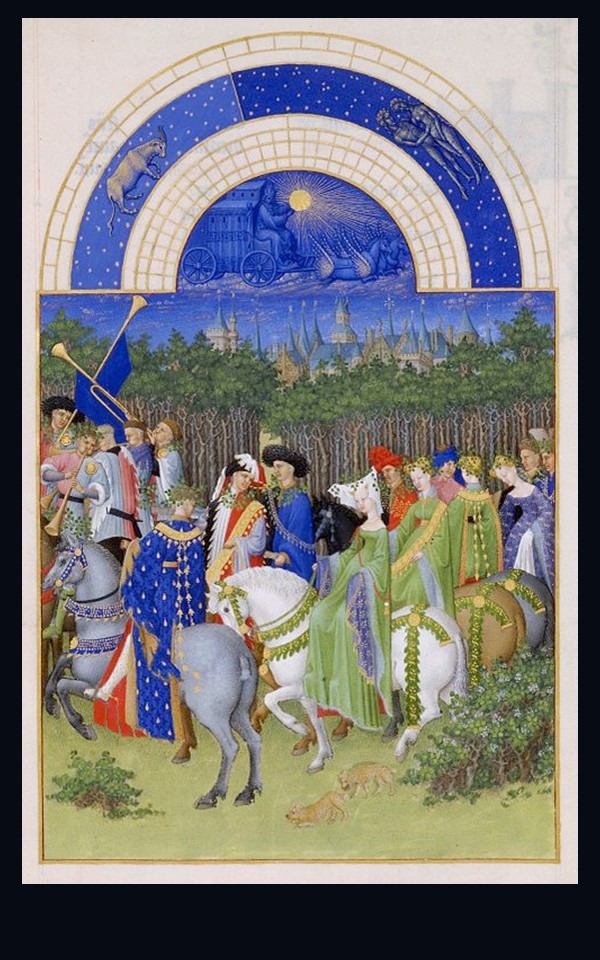
A merry group of horse-riding men and women, wearing their finest garments, May wreaths on their heads, attended by servants and entertained by musicians, this group of elegant aristocrats depicts, according to the Limbourg brothers, a May pageant. In the center of the composition, a young woman, maybe Joan II, Countess of Auvergne and Boulogne, on a white horse, is dressed in a rich traditional green garment, known at the time as “ livrée de Mai.” In front of her, with his back to the viewer, is the Duc de Berry, impressive in his gold-embroidered blue robe, is depicted turning and talking to his bride-to-be.
Paul Limbourg, the probable painter of this page, organized his composition in three levels. The Duke’s entourage occupies the first level displaying vibrant colors, subtle movement and wealth. The second level, a deep, green forest, along with two indications of shrubbery in the very front of the picture, creates an alcove of tranquility, serenity and a sense of safety for the group of aristocrats to continue. Finally, the third level, rendered in lapis lazuli blue, indicates the possible location of this event. The rooftops of Hôtel de Neslé, the Conciergerie and the Tour de l’Horloge in the Isle de la Cité tell us we are in Paris, it’s the 1st of May and it’s time to celebrate!
Herman, Paul, and Johan Limbourg, c. 1385 – 1416
Très Riches Heures du Duc de Berry, the month of May page, c. 1412-1416, manuscript illumination on vellum, 30 cm in height by 21.5 cm, Musée Condé, Chantilly, France
For more information, please check http://www.visual-arts-cork.com/famous-paintings/tres-riches-heures-duc-de-berry.htmhttps://artsandculture.google.com/asset/tr%C3%A8s-riches-heures-du-duc-de-berry-mois-de-mai/VgFhrcA2WNZh6A and https://artsandculture.google.com/asset/tr%C3%A8s-riches-heures-du-duc-de-berry-mois-de-mai/VgFhrcA2WNZh6A
For a Student Activity Worksheet … Click HERE!
For a Picture (Wikimedia Public Domain) … Click HERE!